
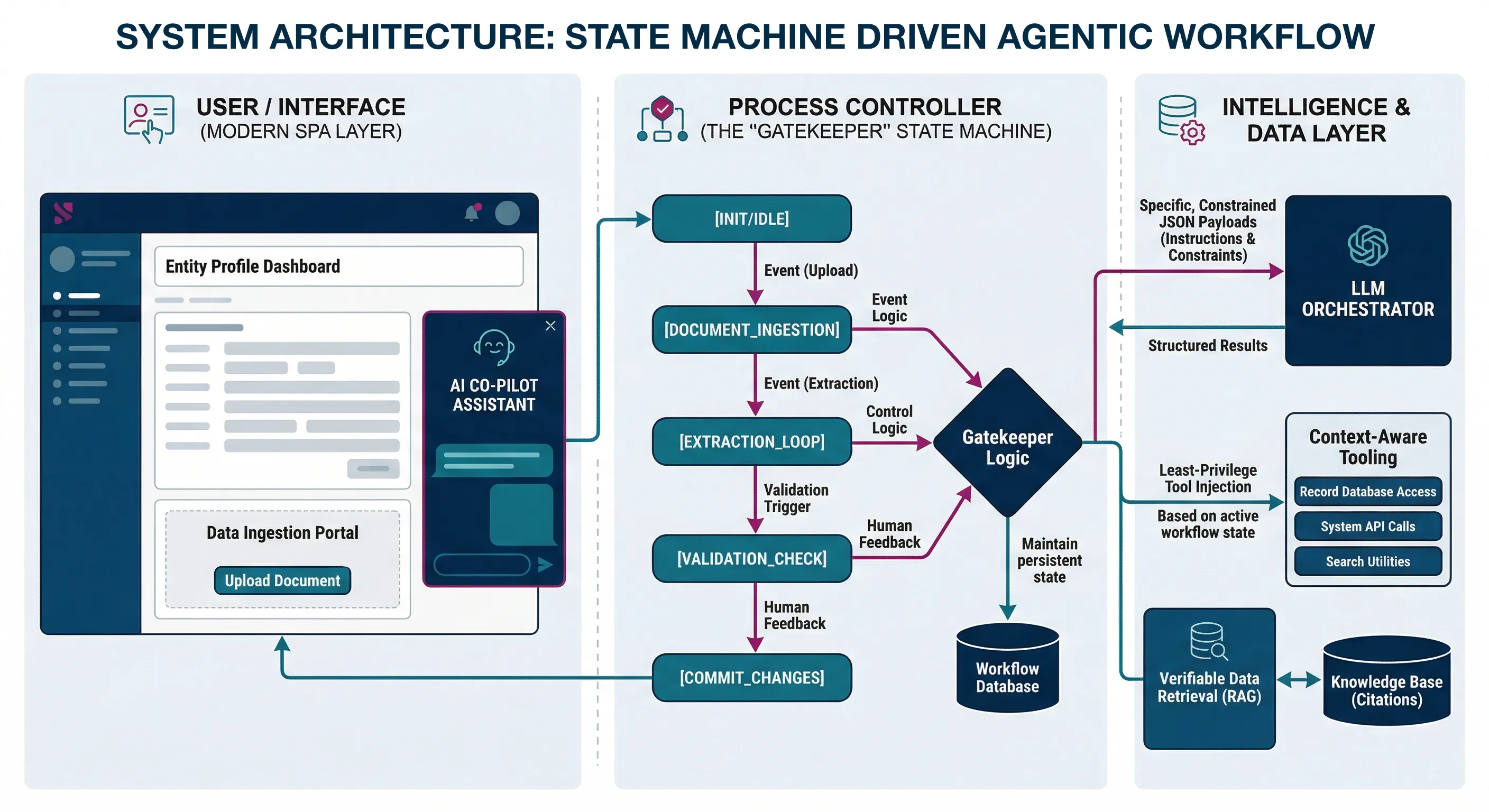
System Architecture: A state machine process controller governs workflow phases, gating agent capabilities and persisting progress independently of the LLM.
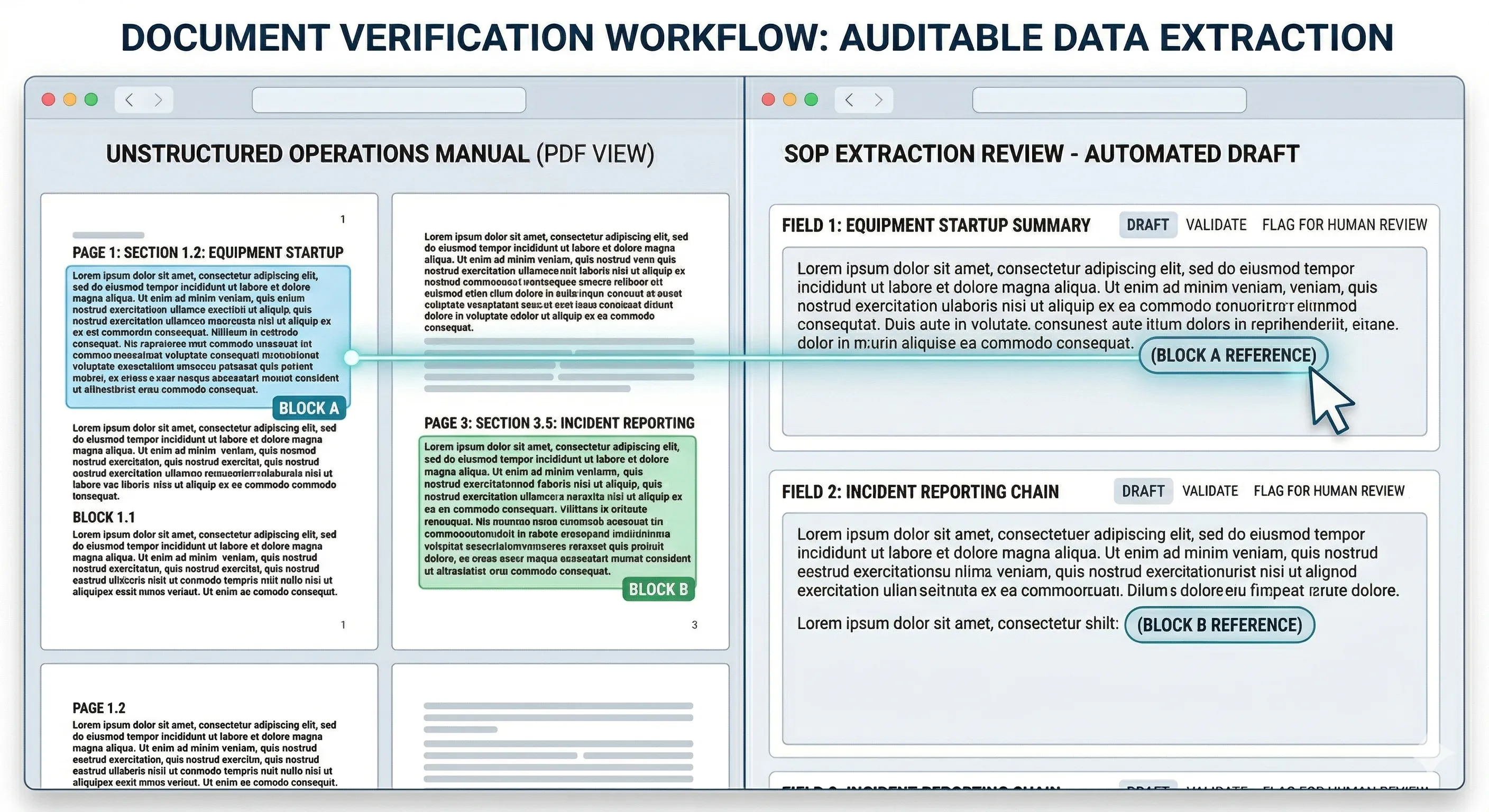
Auditable Extraction: Unstructured document content is mapped to structured compliance fields, each linked to its source block for reviewer verification.
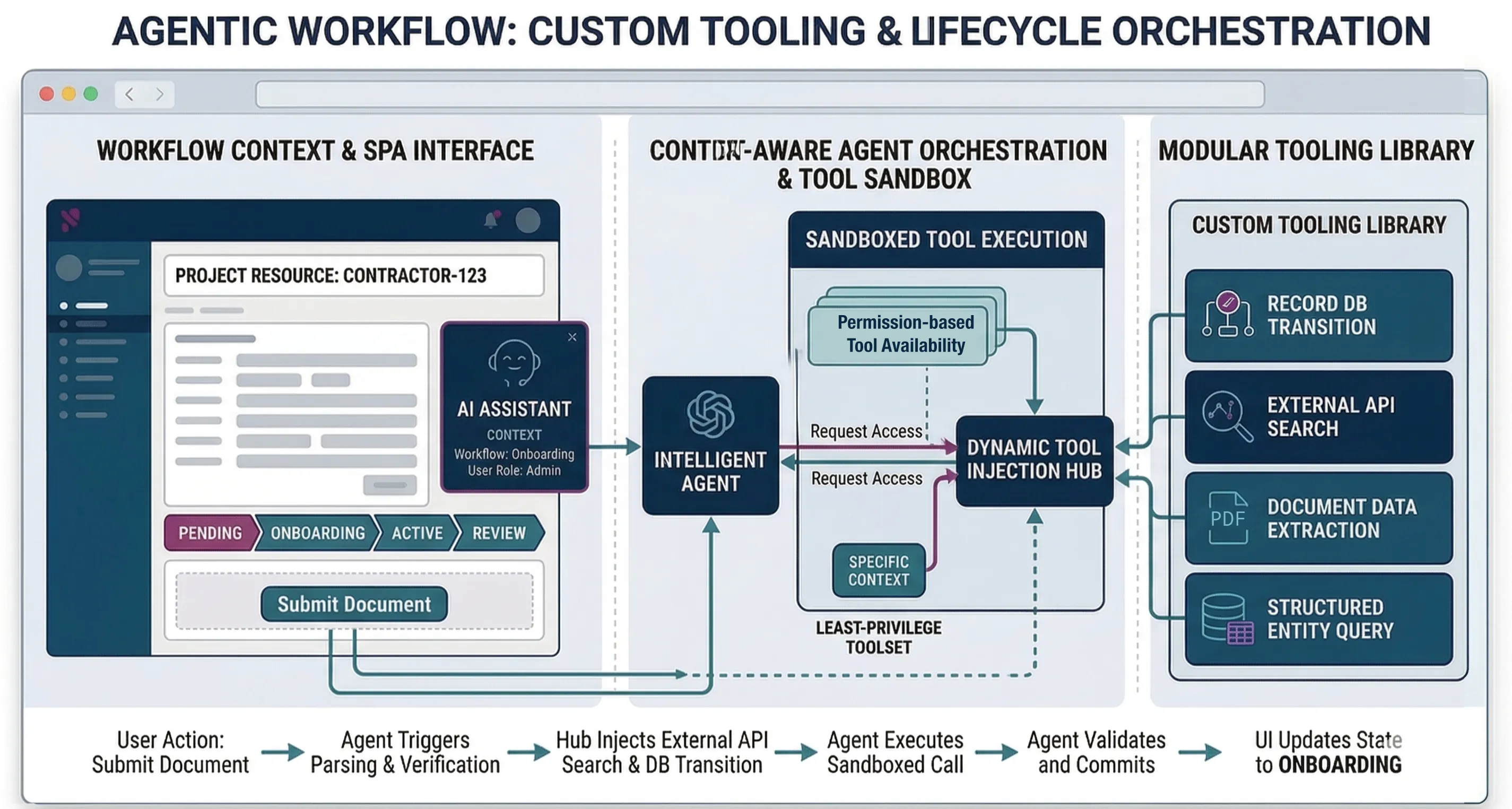
Custom Tooling: A context-aware orchestration layer dynamically injects least-privilege tools based on workflow state and user permissions.
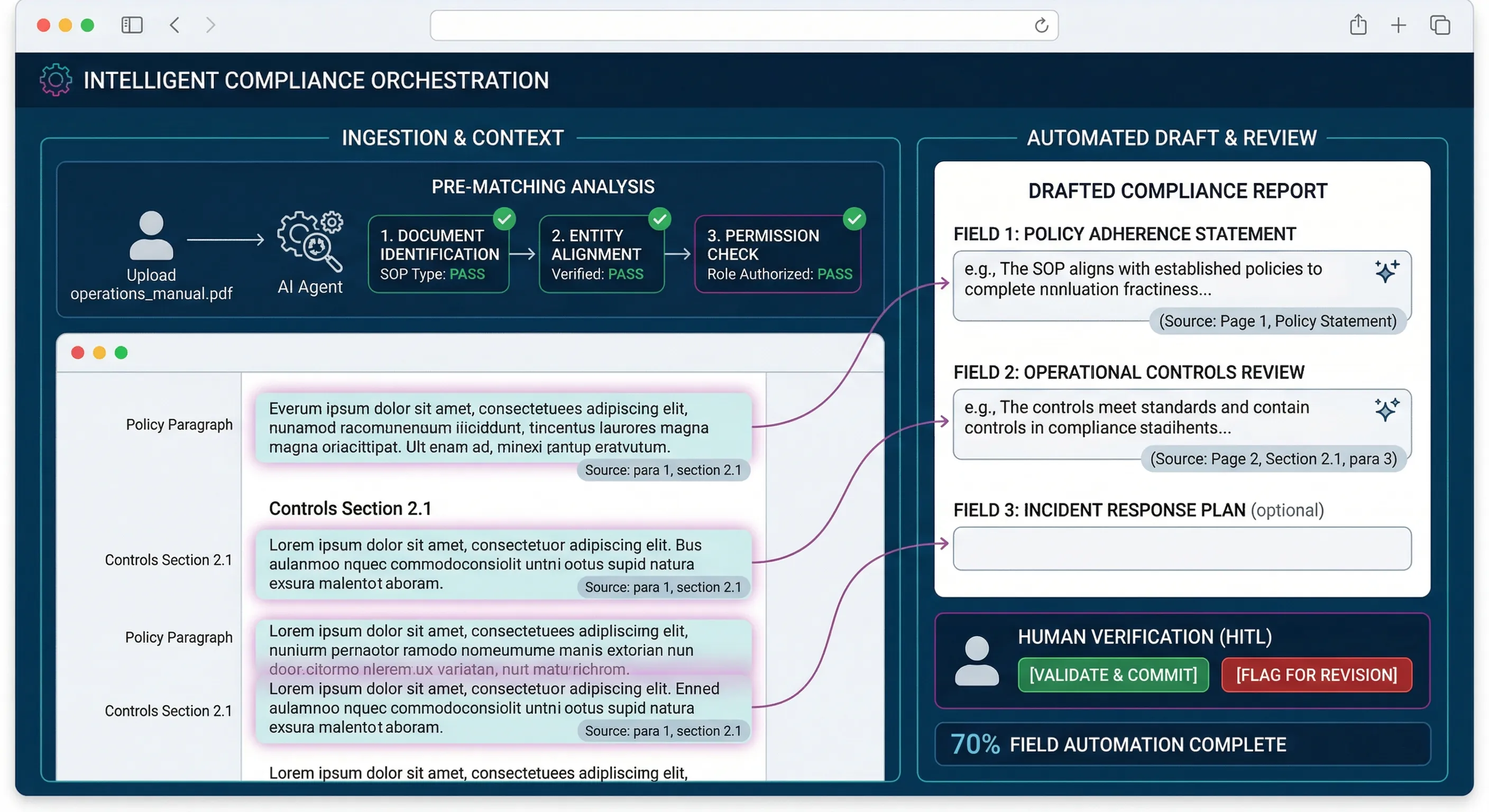
Compliance Orchestration: The automated pipeline ingests documents, runs pre-matching analysis, and drafts compliance fields with human verification gates.
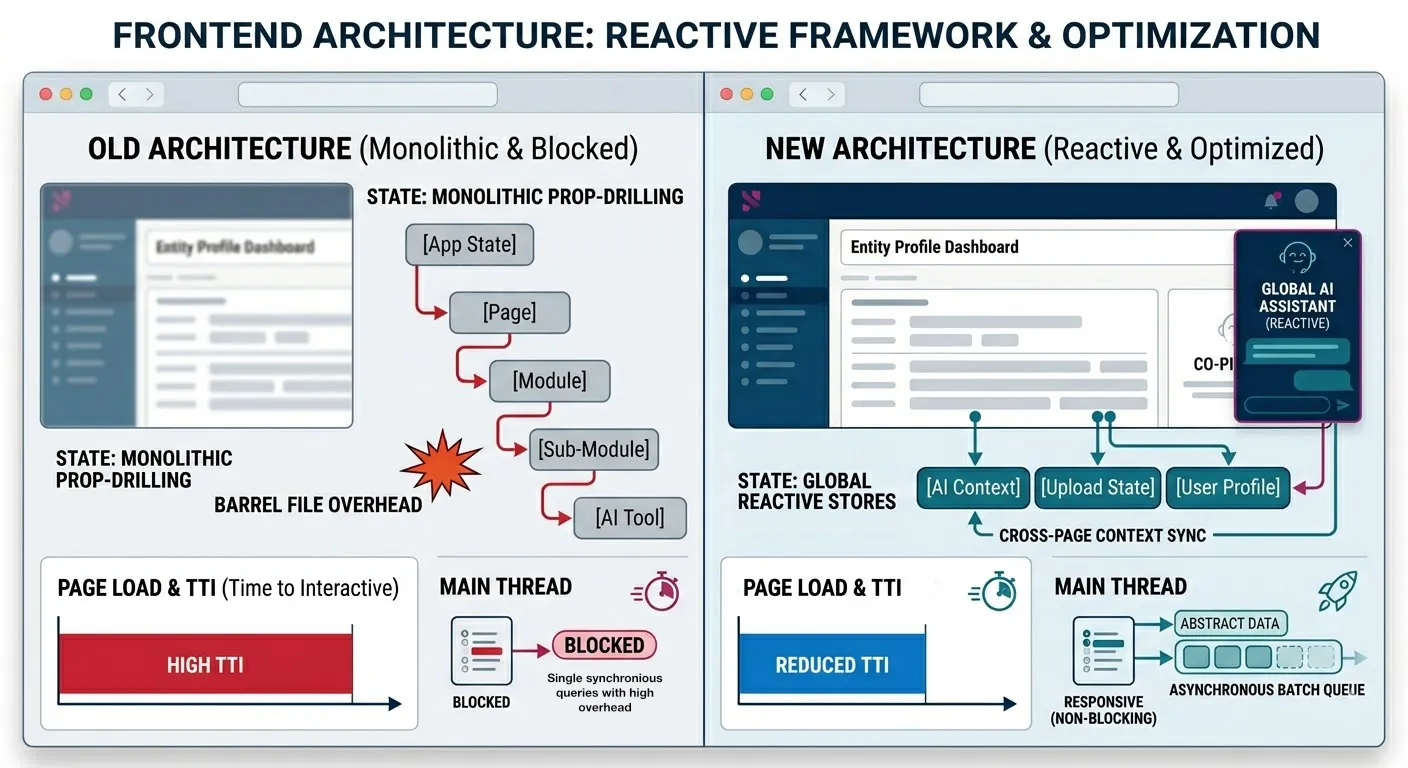
Frontend Optimization: Migration from monolithic prop-drilling to global reactive stores with async batch queries, reducing TTI and unblocking the main thread.
Case Study: AI-Powered Compliance Automation
This project was completed under NDA. Client name, product details, and application screenshots have been withheld. The diagrams shown are original work created to illustrate the architecture and workflows I designed and built.
Result: Significantly reduced manual compliance data entry by automating document-to-field extraction with full audit traceability. Every AI output is linked to its source evidence in the original document. Workflow state persists across page refreshes, navigation, and session interruptions with no user progress lost.
I was contracted to design and build the AI workflow layer for a B2B SaaS compliance platform serving teams in a heavily regulated industry. The platform automates entity onboarding and document verification against multiple overlapping regulatory frameworks.
In this domain, a single non-conforming record can trigger an operational hold. The platform needed to turn unstructured third-party documents into verified database records, and every AI-generated field had to be traceable back to a specific location in the source document. There was no room for a black-box AI that compliance teams couldn't audit.
The existing application already had a document ingestion pipeline and a form field matching system. My scope was the AI intelligence layer: the workflow controller, the chat interface, the context system that connects the two AI surfaces, and the automated compliance pipeline that coordinates them.
Engineering Challenges
Workflow State Management
The compliance workflow involves multiple distinct phases, and each one requires different context, different agent capabilities, and different validation rules. A naive implementation would re-prompt the LLM with full conversation history at every turn. That fails for three reasons: token costs grow linearly with conversation length, context from one phase leaks into the next, and the user loses all progress if they refresh the page or navigate away.
I designed and built an isolated state-management layer that decouples process logic from the LLM prompt entirely. The controller persists workflow phase in the database. When a user returns, it reconstructs exactly where they left off and grants the agent only the capabilities appropriate for that phase. The LLM handles natural language interaction. The controller handles process control. Neither depends on the other's internal state, which means you can swap models, change prompts, or add new workflow phases without breaking the progression logic.
The controller ships with a comprehensive unit test suite covering phase transitions and edge cases.
Context Handoff Between AI Surfaces
The platform has two distinct AI surfaces: a floating chat overlay accessible from any page in the application, and an embedded guidance agent scoped to individual compliance forms. Users start in the floating chat (uploading documents, identifying entities, setting up new records) and then transition to the embedded agent to complete a specific form.
This handoff is deceptively hard. The embedded agent needs the document context from the floating chat, but it shouldn't inherit unrelated conversation history. If the user navigates to a different entity's form, stale context from the previous session shouldn't contaminate the new one. And if the user goes back to the floating chat, their original conversation should still be there.
I built a context-isolation layer that tracks which entity each chat session belongs to. On navigation, the system compares the target entity against the current chat context. If there's a mismatch, the user is warned and offered a clean start while the floating chat state is preserved independently. Handoff only occurs for explicitly approved actions, preventing accidental context leakage between unrelated workflows.
Auditability and Citations
In a compliance context, "the AI filled in this field" is not an acceptable answer during an audit. I built an inline citation framework where every claim the AI makes in conversation is linked to a specific location in the source document. Retrieval results include source metadata so reviewers can click any citation and jump directly to the evidence in the original document. The system assists the reviewer. It never replaces their judgment.
Least-Privilege Agent Capabilities
The agent uses a dynamic capability-injection pattern. Depending on the current page and the user's progress in the workflow, the controller grants access to specific operations: database queries, external lookups, entity creation, or record updates. Capabilities not relevant to the current phase are never loaded. This reduces the attack surface, cuts token overhead, and prevents the LLM from taking actions outside its current scope.
Automated Compliance Pipeline
The core business value is reducing manual data entry. This comes from a multi-stage automation pipeline built into the embedded guidance agent. The agent validates uploaded documents for relevance, extracts and populates form fields with AI-drafted values, detects new or changed records against existing data, and handles bulk field review and approval workflows. Every stage has explicit confirmation gates. The agent proposes. The user decides.
Entity Onboarding
When a user uploads documents, the agent scans for contact information and addresses not already on file. If no matching entity exists, the user can create one directly from the chat, including related records and linkages, without leaving the conversation. I also identified and fixed legacy database issues that had been silently blocking parts of the onboarding workflow across the entire platform. Every creation action requires explicit user confirmation before any write occurs.
Full-Stack Delivery
Serverless Functions: I wrote and modified multiple serverless functions for document classification, document parsing (adding Markdown and plaintext support alongside the existing PDF pipeline), embedding generation, and automated field processing.
Infrastructure: Designed the database schema for workflow persistence and optimized document retrieval for RAG, including entity triggers and background task coordination.
Performance Under LLM Load: Adding AI chat features to an existing single-page application risks degrading the baseline experience. I audited the build pipeline, implemented Vite dependency pre-bundling for heavy AI libraries, built a lazy-loading Markdown renderer that defers rendering dependencies until content is actually displayed, and refactored imports across layout and chat components. I enforced this pattern with a custom ESLint rule. These changes delivered a measurable improvement in Time to Interactive, keeping the app responsive under the added weight of LLM-powered features. The AI assistant is built on Svelte 5 reactive primitives with status polling that never blocks the main UI thread.
Outcomes
- Significant reduction in manual compliance data entry through document-to-field extraction with explicit user verification at every stage.
- Full audit trail: every AI output, in both the chat agent and the automated compliance pipeline, is backed by cited references to the source document.
- Persistent workflow state: multi-step entity onboarding survives page refreshes, navigation, and session interruptions. Context handoff between AI surfaces preserves progress without leaking state between unrelated entities.
- Measurable improvement in Time to Interactive: dependency pre-bundling, lazy loading, and import refactoring kept the app responsive despite the addition of LLM-powered features.
Project Information
- Category: AI/Compliance Automation (Contract)
- Role: Lead Engineer, AI Workflow & Infrastructure
- Client: B2B SaaS Compliance Platform (NDA)
- Timeframe: 2026
- Core Deliverable: Automated Entity Onboarding & Document Verification
Technical Stack
- Frontend: SvelteKit (Svelte 5 Runes), TypeScript, Tailwind CSS
- AI/LLM: Vercel AI SDK, OpenAI (GPT-4o), Perplexity API
- Backend & Data: Supabase (PostgreSQL), Edge Functions
- Testing & Tooling: Vitest, Vite (Custom Performance Warmup), ESLint (Import Guarding)